
Custom Stainless Steel Jewelry: 100+ Piece Minimums
Every minimum in this trade is a tooling decision wearing a number. Stainless steel sits at the top of the published ladder at 100–150 pieces per style, artisan eco-brass at 100 and 925 sterling silver at 50, and the gap between them is set by how much force and machine time each metal needs. This page explains what a 100–150 piece steel run buys a brand, and when a smaller brass run is the smarter first order.
Key takeaways
- 100–150 pcs by style is the published stainless steel minimum; brass is 100 and silver is 50.
- A silver design can be tooled at half the quantity a brass design needs, and under half of a steel run.
- Sampling is 25–35 days and production 3–4 weeks whatever the quantity, so small runs still carry a full calendar.
- 100% inspection and 100% NDA apply to small orders exactly as they do to large ones.
Why the steel minimum sits at the top of the ladder
Stainless steel is a tough alloy. Forming it, laser cutting it and finishing its edges wears tooling faster than casting silver or brass, and a short run cannot absorb that setup cost across enough pieces. The published figures put the difference plainly: artisan brass with recycled content, 925 silver and stainless steel at 100–150 pcs by style. A brand ordering 60 steel bracelets is not asking for a small favour; it is asking a factory to set up a workholding sequence for 60 units.
There is a second reason that has nothing to do with cost. Steel pieces usually go through PVD vacuum plating, and a vacuum chamber run has a sensible batch size. Loading 12 pieces into a chamber built for hundreds wastes the cycle and makes colour consistency between batches harder to hold.
What a 100-piece run actually contains
The quantity on the purchase order is not the work on the shop floor. A 100-piece steel order still passes the 8 documented factory steps: a hand-and-CAD design brief, a prototype through mould or 3D print, the sprue cut, gloss polishing, brushed and textured surface art, PVD vacuum plating, a 100% final QC inspection, and delivery. Every one of those steps is a batch operation with a setup at the front of it.
That is why the calendar does not shrink with the order size. Master sampling is 25–35 days and mass production is 3–4 weeks, and both are quoted as windows rather than as quantities. A 100-piece first order and a 1,000-piece repeat order differ in how long the run step takes, not in whether the sample has to be made and approved.
Reading the minimum as a margin of safety
The practical way to use a minimum is as a sell-through test. If a design has to move 100 units before a second order is worth placing, then 100 units is the amount of stock the launch has to clear — and pricing that assumes it clears in a fortnight is the assumption that breaks first. The manufacturer describes the policy as flexible low MOQ support with minimal inventory exposure, and the numbers behind that phrase are the public ones: 50, 100 and 100–150.
Brands that mix materials in one collection can spread that exposure, and most first approaches to a custom stainless steel jewelry OEM begin with exactly that mix. A silver pendant at 50 pieces carries the display story, a steel bracelet at 100 carries the volume, and neither line has to be tooled at the other's quantity. The MOQ ladder is per design and per material, not per order.
| Base material | Minimum per design | Practical reading |
|---|---|---|
| 925 sterling silver | 50 pcs | Lowest entry point; good for a hero piece |
| Artisan eco-brass | 100 pcs | Full set of plating options over a base metal |
| Stainless steel | 100–150 pcs | Tooling and PVD batch size both need volume |
| Master physical sampling | 25–35 days | One sample window per approved CAD file |
| Mass production | 3–4 weeks | Runs after the sample is signed off |
Worked example: the silver minimum as a share of brass
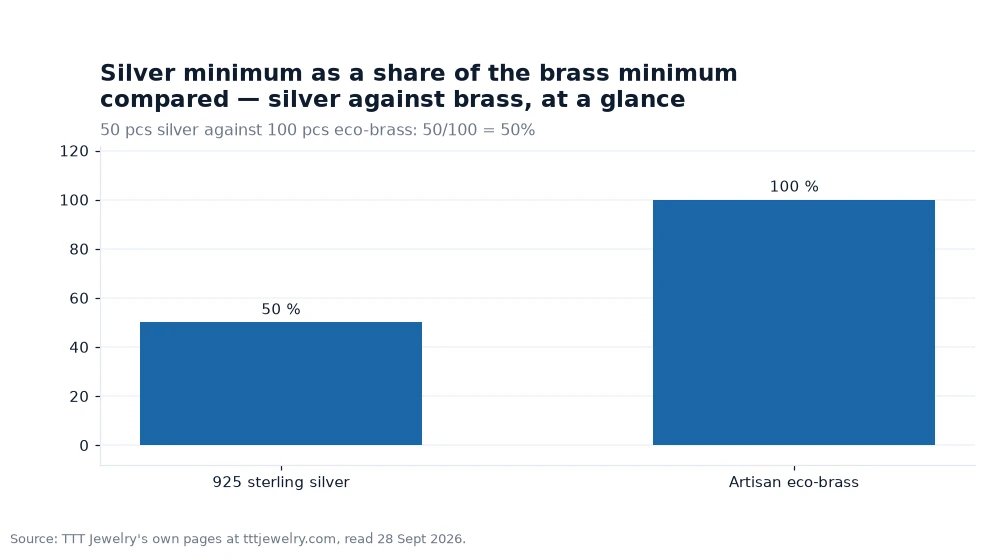
Set the two published minimums side by side. Silver is 50 pieces per design and brass is 100 pieces per design, so the silver minimum is 50 ÷ 100 = 0.5, or 50% of the brass minimum. The silver line can therefore be launched at half the depth of the brass line, which matters when a brand is funding, and every further design repeats the figure.
Run the same ratio against steel. At the bottom of the band, 100 ÷ 50 = 2× the silver minimum; at the top, 150 ÷ 50 = 3×, so a steel launch carries two to three times the stock commitment of a silver one. If a first collection has one design in each material, the smallest possible order is 50 + 100 + 100 = 250 pieces at the bottom of the steel band, and 50 + 100 + 150 = 300 at the top — a useful pair of numbers to have in hand before a planogram is drawn.
The band applies whichever grade is specified. Low MOQ on the stainless line is published at 100–150 pcs by style, and the same figure covers 316L and 304 — the two grades split on application, not on quantity. 316L, with 2–3% molybdenum, 100% waterproof performance and medical-grade hypoallergenic status, is the premium tier for designer and waterproof collections. 304 is the cost-effective tier: water-resistant for daily wear, nickel and lead safe, and reliably vacuum-plated for high-volume programmes.
When brass beats steel for a first order
The plating build: a rhodium layer, PVD plating on stainless work, silver and brass sealed with an anti-tarnish e-coat and 14K/18K/24K gold.
Cost per unit is not the deciding factor here, and nobody should pretend otherwise without a quotation in hand. The deciding question is simpler: does this piece have to survive a shower and a swimming pool? If yes, steel at 100–150 pieces. If it is a seasonal colour story, brass at 100 gets you to market with the same finishing vocabulary.
Frequently asked questions
Can a minimum be split between two designs?
Minimums are quoted per design and per material, so two steel designs are two 100–150 piece commitments rather than one 100-piece order split in half.
Does a larger order shorten the sampling window?
No. Sampling is the 25–35 day window for the master sample, and it stays the same regardless of how many pieces the production run will hold.
What protects a small first order?
Two things, both published: 100% inspection before packing, and a 100% NDA under which moulds, CAD files and collections stay exclusive to the buyer's brand.
Ordering a first run without overcommitting
The least wasteful way through a minimum is to design for it. One silhouette in one material at the stated quantity costs less to prove than three variants at a third of the quantity each, because each variant is its own tooling decision. Start with the metal that matches the wear pattern, hold the other materials for the repeat order, and let the sample do the arguing. Two pages worth reading before that conversation: the factory walkthrough covers the eight production steps in order, and the wholesale programme page sets out how the minimums work across an order book.
What is cited here — the waterproof and sweatproof claim, then the 100–150 pcs per-style stainless minimum, followed by the 316L versus 304 comparison — is documented at the manufacturer's published pages at tttjewelry.com itself, which I read through on 28 Sept 2026. The restatement in hours is my own arithmetic rather than the manufacturer's[1].