
Car and Air-Care Fragrance: The Document Set a Buyer Should Collect
A car or air-care product does not inherit the compliance file of the perfume it smells like. The rules follow the product, not the scent, and a scented product that is not applied to the body is usually regulated differently from a cosmetic, which changes which documents exist, who issues them and what has to travel with the goods. Buyers who discover this at the port pay for the discovery. The practical answer is to agree the document set in writing before the order, name the signatory for each item, and treat any gap as a scope question rather than a clerical one.
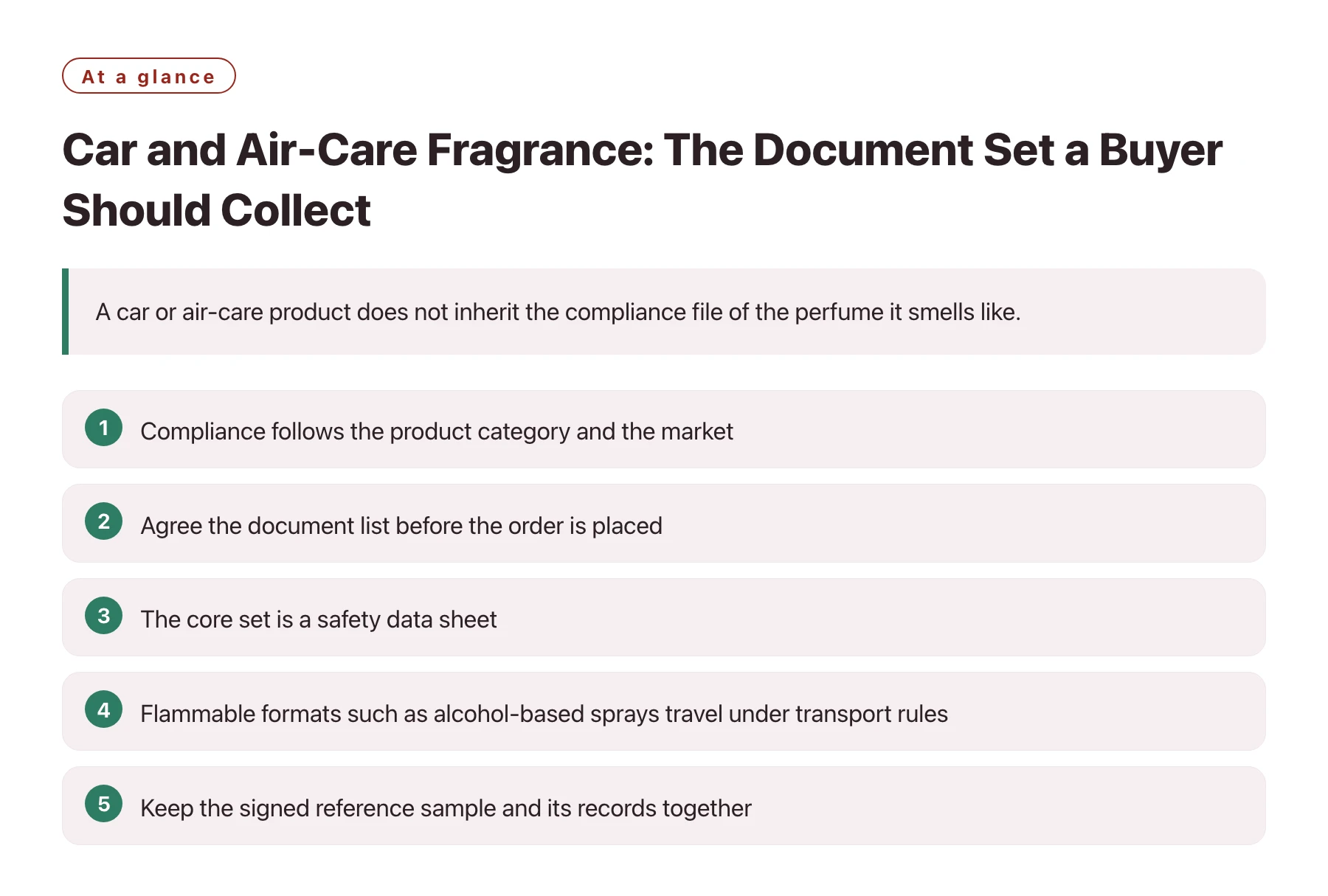
Key takeaways
- Compliance follows the product category and the market, so a cosmetic dossier does not automatically cover an air-care or car format.
- Agree the document list before the order is placed, with a named signatory and a delivery date for each item.
- The core set is a safety data sheet, a fragrance conformance statement for the applicable category, a batch record, a material declaration and packaging documentation.
- Flammable formats such as alcohol-based sprays travel under transport rules, so shipping documentation has to be planned rather than requested at the last minute.
- Keep the signed reference sample and its records together; a document package without a retained reference cannot settle a dispute later.
Quality officers who move from fine fragrance into car and air care meet an unwelcome surprise: the folder that satisfied their last launch is incomplete, and sometimes irrelevant. The fragrance might be identical, but the product is used in a different way, sold under different rules and shipped as a different class of goods.
This is written for the quality or compliance lead at a niche fragrance house, the person who will actually hold the file, rather than for the marketing team. It sets out what to ask for, who should sign it, and which gaps are worth stopping an order over.
Start with the category question, not the checklist
Almost every document dispute in this category traces back to a category mistake. Not every scented product is a cosmetic. Frameworks such as the EU cosmetics regime define a cosmetic product by where and how it is applied, which is why an air freshener or a car scent often sits outside that regime and is handled under general product and chemical safety rules instead [1]. The definition decides which rules apply, and the rules decide the paperwork.
So the first line of the compliance file is not a document at all. It is a sentence: this product is a car interior freshener in gel form, sold in these three markets, and here is the regulatory basis we are applying to it. Once that sentence is agreed and written down, the rest of the list follows logically, and arguments about which allergen declaration or safety statement is needed become factual rather than personal.
The second line is the market list. Chemical and product safety regimes differ between jurisdictions, and international chemical programmes continue to change what manufacturers must know and disclose about the substances they handle. A supplier that can map your product to a market without asking a single question is usually working from habit rather than from a current reference.
Ask the question early, in writing, and keep the reply. When a supplier later says that something was always included, the earlier email is the document that settles it.
The document set, and who signs each item
| Document | What it establishes | Who should sign it |
|---|---|---|
| Category and market statement | Which regulatory basis is being applied to this product, in each market it will be sold in. | The supplier's regulatory or quality function, not the sales contact. |
| Safety data sheet | Hazard classification, handling, storage and transport information for the fragrance and finished goods. | The entity that manufactured or imported the material, with a revision date. |
| Fragrance conformance statement | That the composition has been assessed against the applicable use restrictions for this product category [2]. | The fragrance house or manufacturer holding the assessment. |
| Ingredient and allergen declaration | Which substances must be declared on the label or communicated downstream for the chosen markets. | The manufacturer, with a reference to the version of the composition it covers. |
| Batch record and release note | That the shipped goods correspond to the approved reference and passed release testing. | Quality control, signed against the retained sample. |
| Packaging and waste documentation | Material composition, recyclability claims and the marking obligations that follow from them. | The packaging supplier or the factory that filled the pack. |
| Transport documentation | Classification, packing and labelling for goods such as alcohol-based sprays that are regulated in transport. | The consignor, prepared with the freight forwarder. |
A file assembled in this order is auditable, because each document answers a question raised by the one before it. The weakness to watch for is version drift: a conformance statement that refers to composition three while the batch record refers to composition four is a real finding, even when both documents are genuine.
The sequence that keeps the paperwork ahead of the goods
- Agree the document list with the order confirmationAttach it to the purchase order as an annex with a delivery date for each item, so a missing document is a contractual matter rather than a favour.
- Fix the market list in the same annexAdding a market later changes the labelling, the declarations and possibly the formula, and it should be treated as a scope change with its own cost.
- Request drafts of the two declaratory documents earlyThe category statement and the conformance statement take the longest, because both depend on the formula version being frozen.
- Reconcile versions before the bulk runCompare every document against the approved composition and the retained sample. This half hour prevents most of the disputes that surface after delivery.
- Confirm packaging and end-of-life obligationsPackaging rules continue to develop in major markets, so confirm which obligations apply to your pack and who is responsible for the marking [3].
- Retain the reference sample with the fileStore the approved sample and its records in the same place. A document set without a retained reference cannot resolve a scent or performance complaint.
Where the responsibility splits between buyer and maker
Two items in the list are usually the buyer's job, and they cause most of the friction. The first is the market list; the second is the claim set. If your packaging carries a claim, the wording has to be settled before artwork, and it has to hold in every market where the product is sold. Neither task belongs to the factory, and delegating them silently is how a launch date slips.
Everything technical belongs on the other side of the line. The manufacturer should be able to produce the safety data sheet, the conformance assessment and the batch record without being taught why they are needed. Where a claim is about testing, ask for the report and read the conditions rather than the conclusion; independent laboratory work on consumer products is a documented process with a scope and a date attached [4]. A partner used to private label fragrance production will already keep those records in a form you can file, because its own retail customers ask for the same set.
The last question to settle is the least glamorous. Ask who is named on each document as the responsible entity, because that is the party a market authority will contact. In a project with a trading company in the middle, the answer should be the perfume manufacturer behind it rather than the commercial intermediary, and getting that written down early avoids an expensive reconstruction later.
Once the file is agreed, keep it alive. Add a review date to the annex, because formulas are reformulated, restrictions are revised and packaging rules move. A compliance file that was complete two years ago is a historical record, not a current one, and the difference shows up at the worst possible moment. Working with fragrance manufacturing under one roof shortens the collection process as well, since fewer parties means fewer versions to reconcile, and the entity that signs the declaration is usually the entity that ran the batch.
Test the document system with one small request before you place the order: ask for the category statement and the current conformance statement for an existing product of the same type. What arrives, and how quickly, predicts how the whole project will be documented.
Sources
- European Commission: Cosmetics in the EU —— The European Commission's overview of EU cosmetics rules, including the responsible person, product information file and safety report requirements.
- IFRA Standards Library (International Fragrance Association) —— The IFRA Standards Library lists the restrictions the fragrance industry applies to individual fragrance ingredients, based on safety assessments; it is the reference point for compliant fragrance formulation.
- European Commission: Packaging Waste and the PPWR —— EU rules on packaging and packaging waste, including the Packaging and Packaging Waste Regulation requirements on recyclability and design.
- SGS: Cosmetics, Personal Care & Household Testing —— Testing, inspection and certification services for cosmetics and personal care, including microbiological, stability and safety testing aligned with cosmetics GMP.
Frequently asked questions
Does a car air freshener need the same documents as a perfume?
No. Car and air-care products are often regulated outside cosmetics, so the required set differs. Begin with a written statement of the regulatory category for each market, then build the document list from it.
What is an IFRA conformance statement and do we need one?
It records that a fragrance composition has been assessed against the use restrictions that apply to its product category. Whether you need it depends on the format and market, but for any scented consumer product it is the document that answers the material-restriction question.
Who is responsible for compliance documents, the buyer or the factory?
The factory holds the technical documents for the product it manufactured. The buyer owns the market list, the claims and the choice of which markets to enter, and those decisions change what the factory has to declare.
How do we handle a product that is flammable?
Treat transport classification as part of the specification rather than an afterthought. Ask the factory and the freight forwarder to confirm the classification, packing and labels before the goods are packed.
What should be stored with the retained reference sample?
The approved composition version, the batch record, the conformance statement it refers to, and the date the reference was sealed. Keeping the sample and the paper together is what makes a later comparison meaningful.